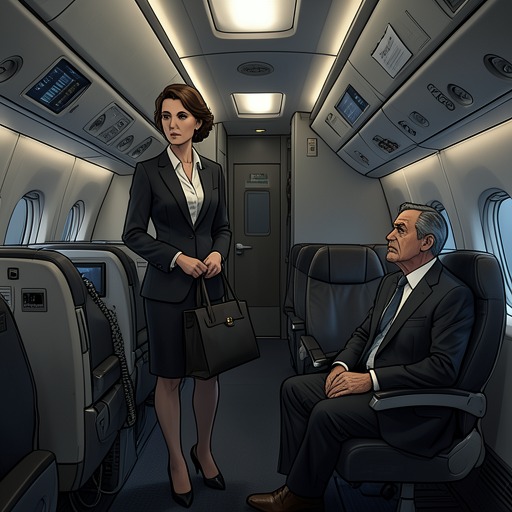
West’s first discovery that she could not fit in an airplane seat
Shrill: Notes from a Loud WomanLindy West’s first discovery that she could not fit in an airplane seat marks the point when air travel changed from an ordinary inconvenience into a recurring calculation of space, exposure, and access. The fall 2013 flight home from Texas made a previously manageable mismatch between her body and the airplane seat impossible to ignore; what followed showed that the burden extended beyond the seat itself, into boarding routines, public judgment, and the effort required to explain the problem.
The return flight
West had always been fat, but before this trip she had generally been able to move through a world built for smaller bodies without attracting much disruption. She already negotiated ordinary constraints: clothing did not fit, and she sometimes had to be mindful of whether a chair would accommodate her. Yet she had remained, by her account, the kind of fat person who mostly fit. In the fall of 2013, that distinction ended.
The preceding year had been professionally busy. West estimates that she had flown about twenty times in the eight months before the incident. On the way to Texas, she fit into her seat; on the flight home, only two days later, she had to squeeze herself into it. The abruptness unsettled her. The change did not arrive as a gradual adjustment she could plan around but as a surprise at the moment of sitting down, in a seat that had not become any larger while she was away.
The seat made the dimensions of air travel concrete. West describes seats as angular, rigid spaces that might be an inch or two narrower than the body trying to fit inside them. Remaining still in one for hours meant folding her arms and shoulders inward and trying to take up less space. She also recalls an eight-hour flight from Oslo to Seattle during which she was frightened by the pressure and pain of being compressed. The immediate discovery in 2013 thus opened onto a broader physical reality: a passenger might pay for a ticket and still find that the space provided did not comfortably accommodate her.
The work of anticipating the next flight
The incident introduced a new kind of dread. Aircraft models and airlines differed in seat widths and belt lengths, so West could not assume that what had worked once would work again. She had to anticipate whether she would fit and whether she would need to request a seat-belt extender, while worrying about the reactions of people seated nearby. The uncertainty began before boarding, not when an inconvenience was already underway.
West developed careful strategies to reduce both discomfort and public attention. She would book only a window seat, accepting the back row or a very early departure to secure one. The space by the window gave her a little more room to position herself, and that seat meant she would not have to pass a seatmate to reach the aisle. She avoided emergency-exit and bulkhead rows because she had found them often narrower. She arrived at least two hours early, even for domestic flights, and waited near the gate so she could board early and settle in before others had to pass her.
Other parts of the routine addressed the prospect of having to move once seated. West used the bathroom multiple times before boarding because she tried to avoid leaving her seat during a flight. She discreetly asked a flight attendant for a seat-belt extender as she boarded, hoping to avoid having to request one after sitting down. These preparations demanded time and attention for every trip; they were not evidence that flying was easy, but ways of managing a system that offered little certainty or room for error.
A seatmate and a public disagreement
A month or two after the first flight on which she did not fit, West boarded an early flight from New York to Seattle and encountered open hostility from a man in the row. She had nearly missed the plane and apologized as she indicated that she would take the middle seat. He did not answer or look at her. While she put her bag overhead, she heard him mutter a complaint. When she asked him to repeat it, he denied having said anything, then eventually responded with disdain.
After the doors closed, no one claimed the window seat. West moved over, noting that the man would not actually have to sit beside her. He answered flatly. Later, when she shifted her backpack and jostled his foot, she said excuse me; they ignored one another for the rest of the flight. West could not know with certainty what had prompted his resentment. What she did recognize was how familiar it felt to have someone’s attention fixed on her body rather than her face, and to sense that her presence was being treated as an offense.
West wrote about the encounter in a short essay for Jezebel on holiday air travel. She intended to describe the low-level hostility fat people faced and the self-doubt that accompanied ambiguous slights. Instead, readers recast her as the aggressor, inventing details about her behavior and challenging her account. Online, the story escalated into claims that she had been drunk, had assaulted the man, or had disrupted the flight. A group of misogynists threatened to report her to the Federal Bureau of Investigation and temporarily arranged search results so a hostile article about her appeared prominently. The response made the essay’s subject larger than one passenger’s conduct: it showed how readily an account of anti-fat hostility could be dismissed while hostility toward fat passengers was voiced openly.
Accessibility and the meaning of the episode
West connects her experience to the ordinary reasons people need to travel. She had flown for work, to attend friends’ weddings, to speak with college students about rape culture and body image, and to hold her father’s hand while he died. The trips were part of her relationships, work, and family life; she refused to reorganize that life simply because the available seats did not fit her body.
Her argument shifts responsibility away from the passenger who cannot fit and toward the service that fails to accommodate her. Airlines, she argues, have little incentive to change without public pressure, particularly while cruelty toward fat people remains socially acceptable. In this account, the central obstacle is not merely a matter of seat dimensions or cost. It is also the judgment that a fat traveler deserves less comfort and care, and that raising the problem is itself an invitation to ridicule.
The episode therefore joins a private moment of physical difficulty to a public dispute over whose experiences are believed. West had already begun questioning a culture that treated fatness as a moral failing and tied human worth to body size; encountering Leonard Nimoy’s Full Body Project had helped her see fat women presented with dignity rather than scorn. The airplane, however, made the consequences of exclusion practical and immediate. A seat that did not fit, a routine built around avoiding embarrassment, and an online campaign against her testimony all pointed toward the same conclusion: blaming the person encountering the barrier does not make the service accessible. For West, the first flight she could not comfortably fit into became the moment that made that barrier impossible to treat as an abstraction.